I'm in the habit of playing Beethoven's "Ode to Joy" quite often on the piano, so I recently played it at an "Open Mic" at FSCJ. Seeing as I was asked a few questions about the piece, I should probably write a short webpage about it.
It appears to have been common practice for composers to set music to poems, as was seen in Beethoven's Ode an die Freude, the last movement of symphony no.9. Since its composition, Ode an die Freude (without lyrics) has become the anthem of the E.U..
The lyrics of the original piece, as I've come to understand them are "Joy, beautiful godspark, daughter of Elysium, here we enter, drunk with fire, holy, your holyplace [heaven?] Your magic [reunites?] again what the fashions [most translations say "tear apart"] All people are again brothers where you soft wing is"
What really made me memorize this poem were two things--
First, the line "wir betreten, feuer trunken, himlische dein heiligtum*." At the time I first heard this song, I was reading that book "American Prometheus: The Triumph and Tradgedy of J. Robert Oppenheimer," trying to convince some people I knew that the reference was to Frankenstein ("Modern Prometheus") and not directly to the Greek myth. As a result of that, Prometheus, (being the Greek deity that gave knowledge of fire), I'd heard had been worshiped by some of the Greeks for his sacrifice. It the seems to me that this line calls "joy" a pleasure that results in the fruits of other people's generosity... It's magic reunites what the times tear apart...
Second, the rhetoric. I don't know why I didn't expect German poems to rhyme! It shouldn't surprise me that the German language, as close to English as it is, uses very similar poetic analysis. This particular stanza appears to be in something like a Trochaic septameter with an ababcdcd rhyme-scheme.
Note to self: poetic form of the Ode has no set structure-- find something like a limmerick or sonnet in German
This is the EU webpage about "Ode to Joy" as a lyricless anthem
This is the link Wikipedia cites for its transcription of the poem
This is Friedrich Schiller's full poem, I think.
This YouTube video is a longer version of the song that fits better with the full poem.
*Review capitalization
At 33 seconds long, I "sung" Ode to Joy, originally "Ode an Die Freude" in German, with lyrics written by Friedrich Schiller, but modified thereafter.
A second song, 1:03 long
My piano sheet music calls this an "Old German Dance."
Next semester I have MAC1105 (college algebra) and ENC1101 (english composition). This is my note to look at their syllabi tomorrow.
Edits: 26 December 2024,
I made Chinese "calligraphy" last Saturday or Sunday.
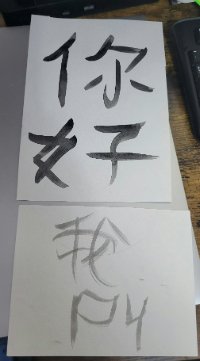
Image uploaded 26 December 2024
你好我叫__. (ni hao wo jiao)."Hello, my name is"
I'll get back to this later.